




-

[Python] Comprehensive Guide to Matplotlib Scatter Plots (ax.scatter): Visualizing 3D and 4D Data
The ax.scatter method in Matplotlib does more than just plot points. By changing the "size" and "color" of the points, you can show 3D or even 4D information on a 2D graph. This article explains everything from basic plots to creating bu... -
【Python】Matplotlibの散布図 (ax.scatter) 徹底解説:3次元・4次元データの可視化とデザイン設定
Matplotlibの ax.scatter は、単に点を打つだけでなく、点の「サイズ」や「色」を変えることで、2次元のグラフ上に3次元以上の情報を表現できる強力なメソッドです。 この記事では、散布図の基本的な描画方法から、バブルチャートの作成、透明度や境界線を... -
[C#] Outputting Logs to Files with NLog (.NET Generic Host)
The standard Microsoft.Extensions.Logging in .NET is excellent, but its default capabilities for "outputting logs to text files" and "log rotation" (switching files by date) are limited. By introducing NLog, a high-performance third-part... -
【C#】NLogを使ってログをファイルに出力する (.NET Generic Host)
.NET 標準の Microsoft.Extensions.Logging は優秀ですが、デフォルトでは「テキストファイルへのログ出力」や「ローテーション(日付ごとのファイル切り替え)」機能が弱いです。 そこで、高機能なサードパーティ製ライブラリである NLog を導入すること... -
[C#] The Correct Way to Include Variables in Log Messages (Message Templates)
When logging with ILogger, it is common to use C# string interpolation ($"") to include variable values in a message. However, for better log performance, readability, and easier analysis in the future, it is recommended to use "Message ... -
【C#】ログメッセージに変数を含める正しい方法 (Message Templates)
ILogger でログ出力を行う際、変数の値をメッセージに埋め込みたい場合、C# の文字列補間式($"")を使って結合してしまいがちです。しかし、ログのパフォーマンスや可読性、将来的な分析のしやすさを考えると、「メッセージテンプレート(Message Templat... -
Setting Log Levels and Filters in C# Code (SetMinimumLevel / AddFilter)
This guide shows how to set log levels and filtering rules directly in C# code without using appsettings.json. You can define fine-grained control as compile-time rules, such as "show warnings and above by default, but only show errors a... -
【C#】コードでログレベルとフィルタを設定する (SetMinimumLevel / AddFilter)
appsettings.json を使用せず、C# のコード上で直接ログレベルやフィルタリングルールを設定する方法です。 「デフォルトでは警告以上を表示するが、特定の名前空間だけはエラー以上にする」といった細かい制御を、コンパイル時のルールとして定義できます... -
[C#] Controlling Log Levels with appsettings.json
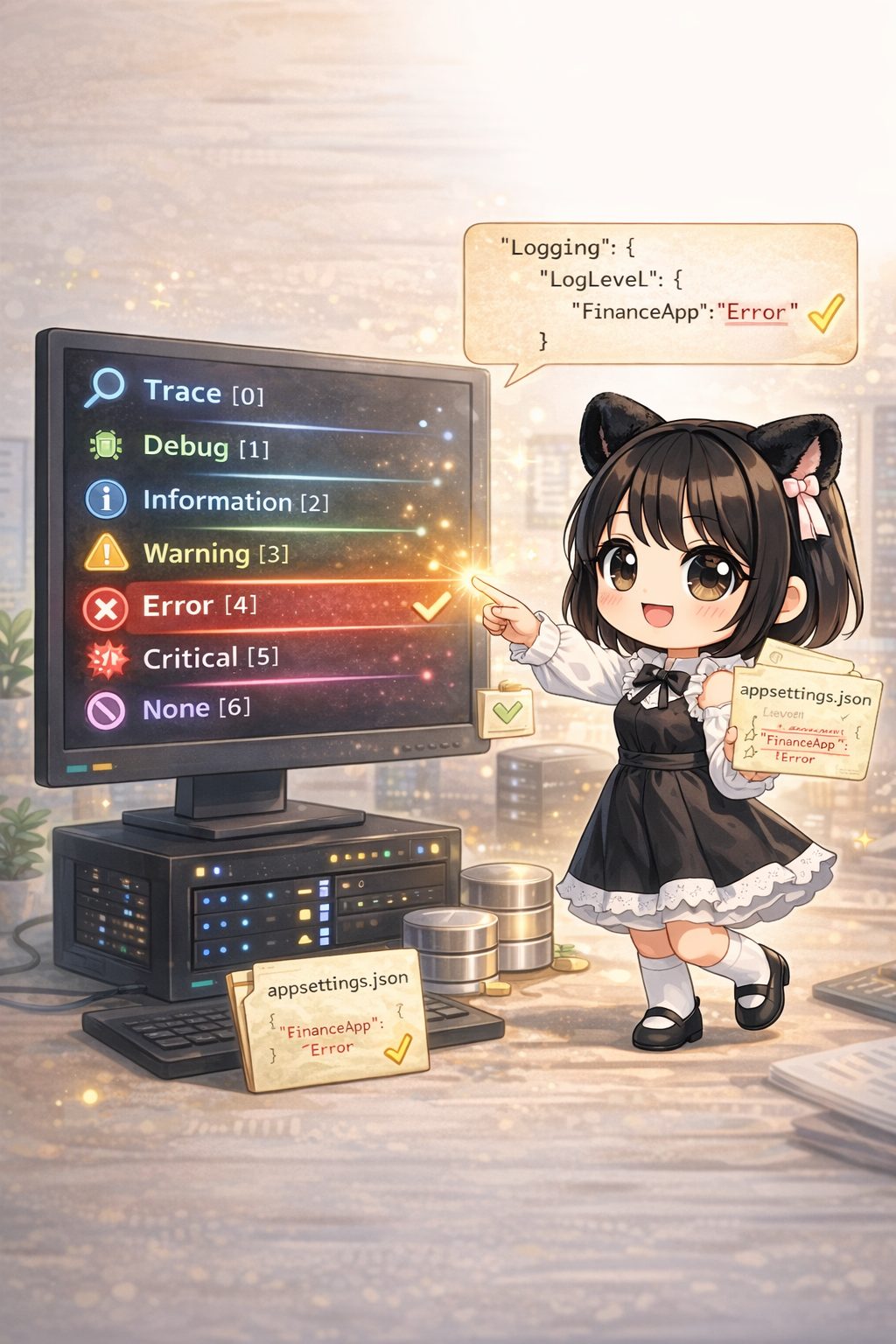
In .NET Core applications, you can adjust which log levels are output by modifying the configuration file (appsettings.json) without changing your source code. This makes it easy to switch between environments, such as showing only error... -
【C#】appsettings.jsonでログの出力レベルを制御する
.NET (Core) アプリケーションでは、ソースコードを修正することなく、設定ファイル(appsettings.json)を書き換えるだけで「どのレベルのログを出力するか」を調整できます。 本番環境ではエラーのみを表示し、開発環境ではデバッグ情報をすべて表示する... -
[C#] Logging with ILogger in .NET Generic Host
For console applications in .NET Core and later (including .NET 5, 6, and 8), the standard method for professional logging is combining Microsoft.Extensions.Logging and Microsoft.Extensions.Hosting. Unlike System.Console.WriteLine, this ... -
【C#】ILoggerを使ってログを出力する (.NET Generic Host)
.NET Core 以降(.NET 5/6/8含む)のコンソールアプリケーションで、本格的なログ出力を行うには Microsoft.Extensions.Logging と Microsoft.Extensions.Hosting を組み合わせるのが標準的な手法です。 System.Console.WriteLine とは異なり、ログレベル... -
Setting Basic Graph Elements with Matplotlib Axes Objects
This guide explains how to set basic elements like titles, axis labels, display ranges (limits), grid lines, and legends using the Matplotlib object-oriented interface (Axes object). These elements are essential for making your data visu... -
【Python】Matplotlibでグラフのタイトル・軸ラベル・範囲・凡例を設定する基本パターンの解説
Matplotlibのオブジェクト指向インターフェース(Axesオブジェクト)を使用して、グラフのタイトル、軸ラベル、表示範囲(リミット)、グリッド線、凡例といった基本的な構成要素を設定する方法を解説します。 データの可視化において、これらの情報はグラ... -
[C#] Extracting a Specific File from a ZIP Archive (ExtractToFile)
Sometimes, instead of extracting every file in a ZIP archive, you may want to search for and extract only one specific file. By using the ExtractToFile method of the ZipArchiveEntry class, you can write the retrieved entry (file informat... -
【C#】Zipアーカイブから特定のファイルだけを解凍・抽出する (ExtractToFile)
Zipファイルをすべて解凍するのではなく、中身を検索して「特定のファイル1つだけ」を取り出したい場合があります。 ZipArchiveEntry クラスの ExtractToFile メソッドを使用すると、取得したエントリ(ファイル情報)を直接指定したパスにファイルとして... -
[C#] Extracting (Unzipping) a ZIP File (ZipFile.ExtractToDirectory)
To extract all files within a ZIP archive to a specific folder, use the ExtractToDirectory method of the System.IO.Compression.ZipFile class. This method is very convenient because it automatically creates the destination folder if it do... -
【C#】Zipファイルを解凍(展開)する (ZipFile.ExtractToDirectory)
Zipアーカイブ内のすべてのファイルを、指定したフォルダーにまとめて解凍するには、System.IO.Compression.ZipFile クラスの ExtractToDirectory メソッドを使用します。 このメソッドは、解凍先のフォルダーが存在しない場合に自動的に作成してくれるた... -
[C#] Getting a List of Files in a ZIP Without Extracting Them (ZipArchive.Entries)
It is common to want to check the contents of a ZIP file or verify if a specific file exists before extracting everything. By using the System.IO.Compression.ZipFile.OpenRead method, you can quickly access the information (entries) withi... -
【C#】Zipファイルを解凍せずに中身のファイル一覧を取得する (ZipArchive.Entries)
Zipファイルをすべて解凍する前に、「中にどんなファイルが入っているか確認したい」「特定のファイルだけが存在するかチェックしたい」という場面はよくあります。 System.IO.Compression.ZipFile.OpenRead メソッドを使用すると、ファイルを展開すること... -
[C#] Deleting a Specific File in a ZIP File (ZipArchiveEntry.Delete)
Sometimes, after creating a ZIP archive, you may want to remove only specific files. For example, you might have included log files by mistake or want to exclude old configuration files from the archive. To perform this operation, you mu... -
【C#】Zipファイル内の特定のファイルを削除する (ZipArchiveEntry.Delete)
Zipアーカイブ(圧縮ファイル)を作成した後、特定のファイルだけを取り除きたい場合があります。 例えば、ログファイルを含めて圧縮してしまったが後から削除したい場合や、古い設定ファイルをアーカイブから除外したい場合などです。 この操作を行うには... -
[C#] Adding and Appending Files to an Existing ZIP File (ZipArchiveMode.Update)
To add new files to a ZIP file that has already been created, or to update existing files, open the file using the ZipFile.Open method with ZipArchiveMode.Update. Once the ZipArchive object is opened in this mode, you can easily add file... -
【C#】既存のZipファイルに新しいファイルを追加・追記する (ZipArchiveMode.Update)
既に作成済みのZIPファイルに対して、後から別のファイルを追加したり、既存のファイルを更新したりするには、ZipFile.Open メソッドで ZipArchiveMode.Update モードを指定して開きます。 このモードで開かれた ZipArchive オブジェクトに対して CreateEn... -
[C#] Compressing a Directory to a ZIP File (ZipFile.CreateFromDirectory)
To combine the contents of a specific directory into a single ZIP file (archive), it is standard to use the CreateFromDirectory method of the System.IO.Compression.ZipFile class. Using this method allows you to complete the compression p... -
【C#】ディレクトリ(フォルダ)をZIPファイルに圧縮する (ZipFile.CreateFromDirectory)
指定したディレクトリの中身をまとめて1つのZIPファイル(アーカイブ)にするには、System.IO.Compression.ZipFile クラスの CreateFromDirectory メソッドを使用するのが標準的です。 このメソッドを使うと、面倒なストリーム操作を記述することなく、1行... -
[C#] Handling Strings as a Stream (MemoryStream)
There are situations where you want to test a method that accepts a file, but creating a physical file is a hassle. You might also want to process string data received from a network in the same way you would handle a file. In such cases... -
【C#】文字列をStream(ストリーム)として扱う (MemoryStream)
「ファイルを受け取るメソッドをテストしたいが、わざわざ物理ファイルを作るのは面倒」という場面や、「ネットワークから取得した想定の文字列データを、ファイルと同じように処理したい」というケースがあります。 そのような場合、文字列(string)をバ... -
[C#] Writing Byte Array Data to a File (FileStream.Write)
When saving byte[] (byte array) data—such as image data, communication packets, or custom binary formats—as a file, using the FileStream class allows for flexible writing. While there is a simple method called File.WriteAllBytes to write... -
【C#】バイト配列のデータをファイルに書き込む (FileStream.Write)
画像データや通信パケット、あるいは独自のバイナリ形式など、byte[](バイト配列)のデータをファイルとして保存する場合、FileStream クラスを使用することで柔軟な書き込み処理が可能になります。 単にすべてのバイトを書き込むだけであれば File.Write...
-

【Python】読みやすいテストの秘訣「Arrange-Act-Assert」パターンとは?
-

Djangoモデル設計のアンチパターン:「有意コード」がもたらす技術的負債
-
【Excel】セルに定義された名前を削除する方法
-
Excel VBAでグラフを複製し、新しいデータを設定する方法
-
【VBAフォーム】Tab不要で自動的に次のTextBoxへ移動させる方法とは?
-
【C++】std::tuple の使い方 | 複数の異なる型の値を一つにまとめる方法
-
[Excel VBA] No More Mojibake! How to Export CSV Files in UTF-8 (ADODB.Stream)
-
Python Inner Functions (Nested Functions): Benefits and Usage of Defining Functions Inside Functions