-

[Excel] How to Disable the “Personal Information Warning” on Save
Introduction When working in Excel, you may encounter the following message every time you save a file: "Be careful, parts of your document may include personal information that can't be removed by the Document Inspector." If this messag... -
[Excel] How to Create a Dropdown List That Allows Free Input
Introduction When using Excel, there are often times when you want to restrict the values that can be entered into a cell. "Data Validation" is the go-to feature for this. For example, you might want to set up a list in a cell so users c... -
[Excel] How to Plot a Specific Value on a Graph Line | Using Linear Interpolation
Introduction When plotting data on a graph, have you ever found yourself manually placing a shape on a dotted line, wondering, "Where exactly does this value fall?" I used to manually paste red dots while looking at the numbers, but this... -
[Excel] How to Change “m2” to “m²” | Superscript Formatting
Introduction In Excel, you may want to display units like square meters ("m2") with the "2" showing as a small number at the top right, like "m²". Here is how to format the text to achieve this appearance. Steps Here is the procedure: Op... -
[Excel] How to Fix Missing Chart Legends | Causes and Solutions
Introduction When creating a chart in Excel, the legend may not display correctly. You might encounter a situation where the "Select Data" screen lists 4 series, but the actual graph only displays 3. In this article, I will first explain... -
[Excel] How to Remove Decimals from Chart Axis Labels | Beginner’s Guide to Displaying Integers
Introduction When you create a chart in Excel, the axis labels often automatically display with decimal points, such as "1.0" or "2.0", even when your data consists only of integers. To make your chart look cleaner and easier to read, yo... -
[Excel] Why Columns Shift When Copying Formulas and How to Fix It
Introduction When working in Excel, have you ever experienced a situation where you just wanted to copy a formula, but the columns or rows shifted unexpectedly? "I just wanted to copy the calculation, but the reference cells moved on the... -
[[Excel Technique] How to Remove an Excel Table | Beginner’s Guide to Converting to a Normal Range]
Introduction When organizing data in Excel, many people use the convenient "Table" feature. Using a table automatically tidies up the appearance and makes setting filters and styles easy. However, when actually using it, there are times ... -
[Excel] How to Calculate Elapsed Time Between Two Dates | Technique to Display in “h:mm:ss” Format
Introduction When managing work logs or event records in Excel, you often encounter situations where you need to accurately calculate "how much time has passed from one date and time to the next." For example, let's look at the following... -
[Excel] How to Link Shape Text to Cell Values
Overview In Excel, you can link the text displayed in shapes (such as rectangles or text boxes) to cell values. When the cell is updated, the display within the shape changes automatically. This article explains the setup procedure using... -
[Excel] How to Count in “0.5” Increments | Steps to Carefully Handle Blanks and Specific Values with COUNTA and COUNTIF
Overview This article introduces methods for handling Excel aggregation requirements such as "basically counting cells as 1, but counting 7 and 8 as 0.5." We will carefully explain practical formula patterns using COUNTA, COUNTIF, and SU... -
[Excel] Causes and Solutions for “The file couldn’t be opened in Protected View”
Introduction When trying to open a file in Excel, you may have encountered the message: "The file couldn't be opened in Protected View." This can prevent you from proceeding with your work. It can be particularly frustrating when the err... -
[C++] How to Use std::unique_ptr | Smart Pointers to Automate Memory Management
Introduction When dynamic memory is allocated using new in C++, it must always be manually released using delete. Forgetting to do so causes memory leaks. To solve this problem, C++11 introduced std::unique_ptr, a smart pointer that auto... -
[C++] How to Use std::pair | How to Handle Two Values as a Pair
Introduction When programming in C++, you often encounter data that needs to be treated as a pair, such as "key and value," "first name and last name," or "x-coordinate and y-coordinate." For this purpose, the C++ standard library <ut... -
[C++] What are Static Members? | How to Use Variables and Functions Shared by the Entire Class
Introduction In C++ classes, member variables (data members) usually hold individual values for each object. If you create two objects, car1 and car2, from a Car class, their gas (gasoline level) is managed separately. However, there are... -
[C++] Thorough Explanation of Lambda Expressions | Captures and Generic Lambdas
Introduction When using standard algorithms like std::sort or std::find_if in C++, defining a separate function just to specify a condition can be tedious. Lambda expressions, introduced in C++11, answer the need for "disposable, simple ... -
[C++17] How to Use std::variant | Handling Multiple Types with Type-Safe Unions
Introduction In C++, you may want a variable that can store one of several different types, such as "maybe an int, maybe a string." Conventional unions solve this problem, but they have low type safety because you have to manage which ty... -
[C++] How to Use std::shared_ptr | Smart Pointers for Shared Ownership
Introduction std::unique_ptr in C++ is a smart pointer that guarantees a resource has only one owner. However, there are times when you want to share and use the same object from multiple locations. std::shared_ptr realizes this "shared ... -
[C++] What is a Destructor? | Automatic Cleanup When an Object is Destroyed
Introduction Just as a C++ constructor is an initialization process called automatically the moment an object is "born," a Destructor is a special member function called automatically just before an object "vanishes" from memory to perfo... -
[C++/C] How to Batch Copy (Assign) All Struct Members with =
Introduction In C++ and C structures (struct), there are cases where you want to copy the contents of one variable exactly into another variable. While it is possible to copy members one by one like destination.id = source.id;, this beco... -
[C++] Thorough Explanation of the 4 Types of Casts (static_cast, dynamic_cast, etc.)
Introduction In C++, four different cast operators are provided to perform explicit type conversion (casting), such as converting an int to a double, or a parent class pointer to a child class pointer. These are safer than the old C-styl... -
[C++] What are Inline Functions? | How to Implement Member Functions Inside Class Definitions
Introduction In C++ classes, it is common practice to "declare (prototype)" member functions inside the class definition and "implement (process content)" them outside the class. However, for functions with very short processing, writing... -
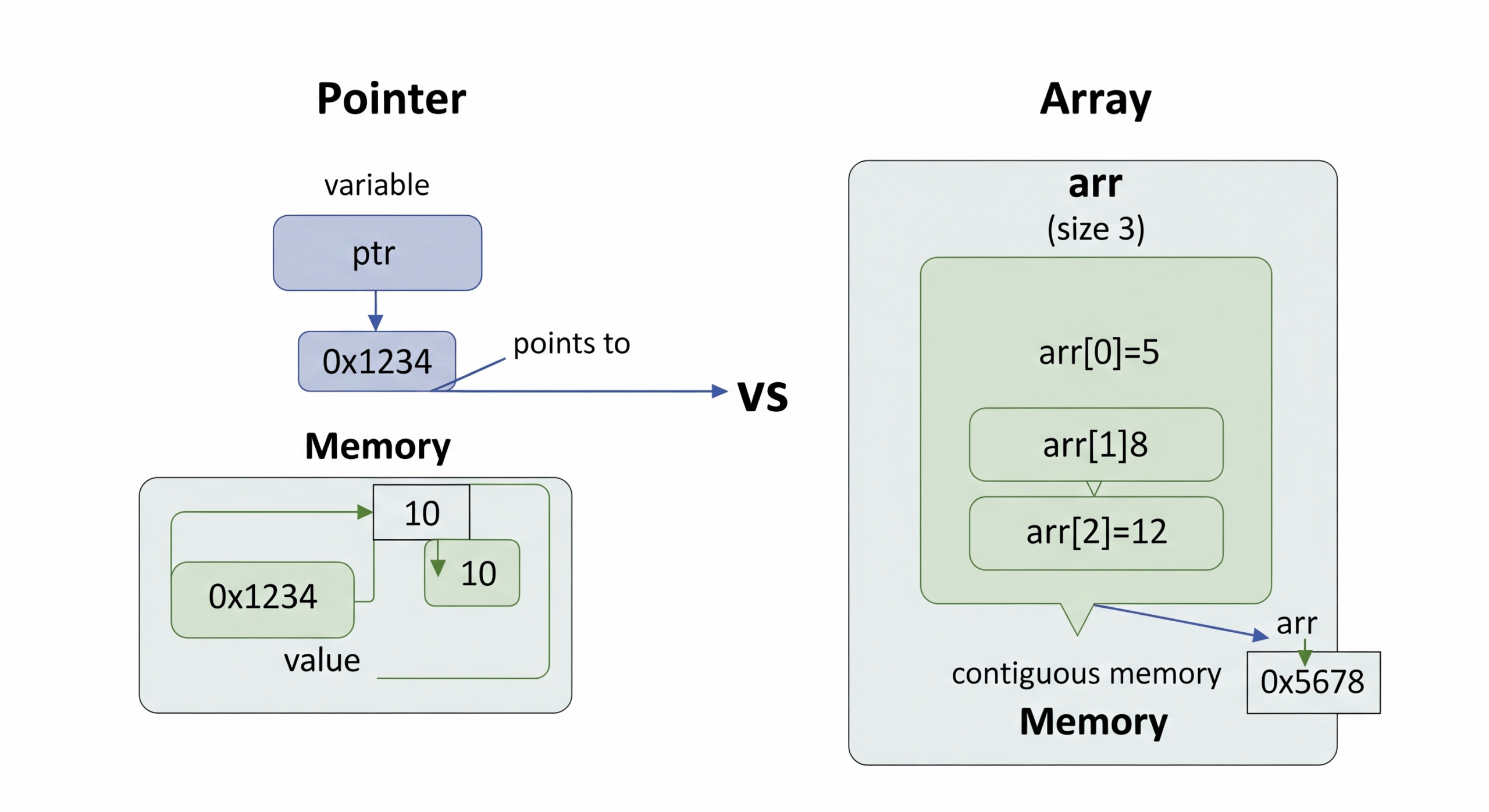
[C++/C] Thorough Explanation of the Difference Between Pointer (const char*) and Array (char[])
Introduction When handling C-style strings in C++ or C, there are two very similar methods: Using a Pointer: const char* ptr = "text"; Using an Array: char arr[100]; These are similar yet distinct, and using them without understanding th... -
[C++] Introduction to Templates | How to Create Generic Functions and Classes
Introduction C++ Templates are a powerful feature that allows you to write generic code by parameterizing types. They not only generalize functions and classes but also dramatically improve the expressiveness of C++, enabling handling of... -
[C++/C] What is typedef? | How to Alias Existing Data Types for Better Readability
Introduction When programming in C++ or C, data type names can sometimes become very long, such as unsigned long long int. Additionally, there are times when you want to distinguish the "meaning" of variables within the program, even if ... -
[C++] How to Use String Streams (stringstream) | Reading and Writing Strings in Memory
Introduction In C++, there are frequent situations where you want to convert numbers to strings, convert strings to numbers, or split a space-separated string into individual words. By using "String Streams" provided by the standard libr... -
[C++/C] Usage of Nested Structures | How to Structure Complex Data
Introduction Structures (struct) in C++ and C are convenient features for grouping related variables into one unit, but their true value is demonstrated when they are nested. You can have a variable of another structure type as a member ... -
[C++] How to Use std::lock_guard and std::unique_lock | Safe Mutex Management
Introduction In multi-threaded programming, if multiple threads access the same data (shared resource) simultaneously, it can lead to data corruption or unexpected race conditions. To prevent this, we use exclusive control (locking) with... -
[[C++/C] How to Use Arrays of Structures | Managing Multiple Records Together]
Introduction C++ and C structures (struct) are useful for grouping related data into one unit, but their true value is unlocked when combined with arrays. By defining an "Employee" structure and then declaring an array of that structure ... -
[C++] How to Use .size() and .length() to Get Character Count of std::string
Introduction When handling std::string in C++, there are frequently situations where you want to retrieve the "length" (i.e., how many characters are contained) of the string. For this purpose, the std::string class provides two member f...